

Hair Loss Awareness Month: What Dermatologists Know About Shedding and Solutions
Few things spark panic like extra hair in the shower drain. But when does normal shedding cross into true hair loss? And what can you actually do about it?
Hair plays a powerful role in how we see ourselves. It defines who we are and gives us confidence. So if you’re noticing your part is widening, your ponytail feels thinner, or you’re shedding more than usual, this is the right time to understand what’s happening and what you can do about it.
Here’s the good news: Not all hair loss is permanent. And there is plenty you can do about it.
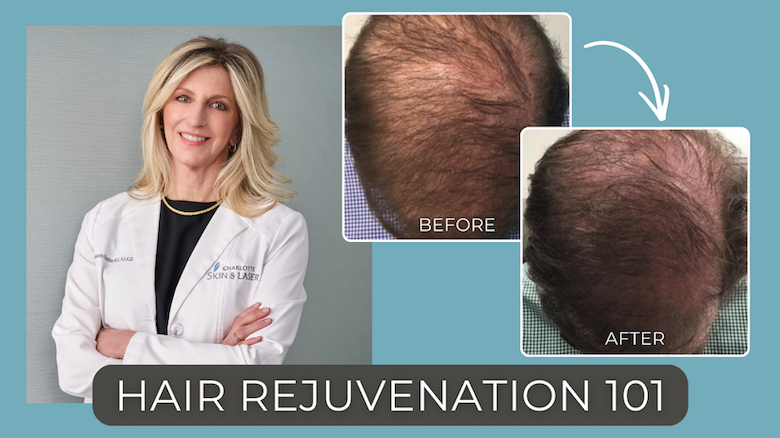
In Episode 40 of Queen City Skin, Dr. Elizabeth Rostan and Robyn Allen, RN, walk through how dermatologists diagnose and treat hair loss, why some shedding reverses while other thinning is treatable, and why combined approaches work better than any single solution. If you’ve been wondering whether early intervention is worth it, this is your answer.
Listen to Episode 40: Regrowing Hair in August | Understanding Shedding, Thinning, and Real Solutions
What Happens During a Hair Loss Consultation?
When you come in for a hair loss evaluation, the process is thorough and personal.
You’ll complete a detailed questionnaire about your hair loss timeline, diet, hormonal changes, and stress. Dr. Rostan reviews this carefully before seeing you to understand your story. Then photos are taken from multiple angles: front, back, and sides. These photos matter. They’re not just for the clinic; they’ll help you see changes at each visit and confirm that treatment is working!
During the exam, Dr. Rostan uses magnifying loops and dermoscopy (a specialized way of looking at your scalp) to assess the health of your hair follicles and scalp. She may also do a hair pull test – gently tugging on 10-15 hairs to see how many come out and whether they break or release at the root. And yes, ideally you come in with hair that hasn’t been washed for a couple of days, because washing doesn’t cause hair loss, it just facilitates the hair that’s already destined to come out. Think of it like using oil to remove sticky tape.
Blood work often follows: iron, vitamin D, magnesium, thyroid, and a basic metabolic panel. Low iron can drive hair loss, and Dr. Rostan treats low-normal ferritin aggressively, even if labs say it’s “normal.” Low vitamin D and magnesium don’t cause hair loss, but supporting these levels helps with regrowth.
Types of Hair Loss And How They're Different
Telogen Effluvium (Stress-Related Shedding)
Telogen effluvium happens when hair prematurely enters a resting phase and sheds weeks later. Common triggers include stress, illness, surgery, significant weight loss, or medications like GLP-1 inhibitors.
Dr. Rostan explains it perfectly: Imagine you have a beautiful houseplant – say, a ficus tree. You go on vacation and forget to water it. At first, nothing happens. The plant looks fine for a good long while. Then all of a sudden, all the leaves fall off. You panic and ask: did someone break it? The answer is no. The roots are fine. And once you start watering it again, fertilizing it, taking care of it, the leaves grow back.
That’s telogen effluvium. Your body has had an insult – stress, illness, a medication change – and it goes into a kind of hold-back mode. More hair enters the resting phase. But the roots are healthy. The hair will grow back once the trigger is addressed and your growth cycle resets.
Androgenetic Alopecia (Pattern Hair Loss)
This is driven by hormones and genetics. In men, it’s male pattern baldness. In women, it shows up as female pattern thinning: a widening center part, thinning at the temples or crown, a receding hairline. Women do not go bald without a significant hormone disorder; we experience gradual density loss instead.
Pattern hair loss doesn’t reverse on its own, but it is highly treatable – especially when caught early.
Other Types Worth Knowing About
Alopecia areata is an autoimmune condition causing patchy hair loss. Scarring alopecia, including central centrifugal cicatricial alopecia (CCCA), requires early intervention to prevent permanent hair loss. If you’re experiencing patchy loss or localized areas of concern, professional evaluation is especially important.
Schedule A Consultation
Integrating The Art of Medicine with the Science of Beauty
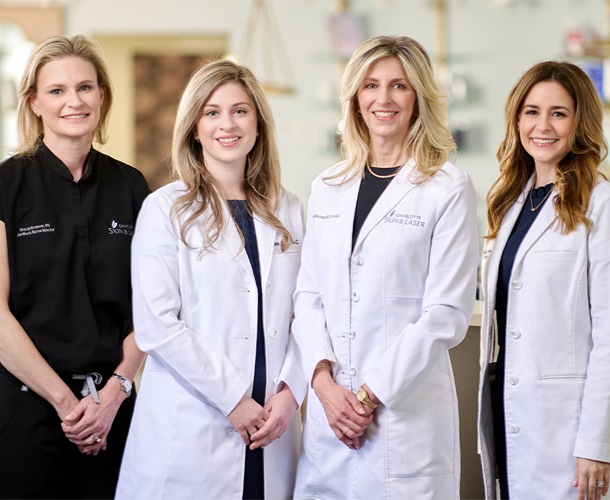
At Charlotte Skin & Laser, we offer personalized skincare with a boutique touch—combining medical expertise and aesthetic artistry to deliver natural, results-driven care. From skin checks to rejuvenation, our expert team is here to guide you.
When Should You See a Dermatologist?
You don’t need to wait for dramatic hair loss. Early evaluation unlocks better outcomes because treatment works best when hair follicles are still active.
Schedule a consultation if:
- You’re noticing sudden shedding after stress, illness, surgery, or medication changes
- Your part is widening or your hairline is receding
- Your ponytail feels thinner than it used to
- You’re experiencing patterned thinning rather than diffuse loss everywhere
What Actually Works: Treatments That Matter
Oral Medications
Low-dose oral minoxidil works for most people. Dr. Rostan typically starts women on half a tablet and healthy men on a full tablet. Side effects can include mild dizziness, leg swelling, or unwanted facial hair growth (about 20% of women). It takes time… like all hair treatments… but the results are real.
For pattern hair loss, 5-alpha reductase inhibitors (finasteride, dutasteride) are the gold standard. Recent research shows dutasteride 0.5mg is the most effective treatment for androgenetic alopecia.
Topicals & Supplements
A compounded prescription combining finasteride 1% and minoxidil 7% targets problem areas directly.
Viviscal Pro is the most well-studied supplement with placebo-controlled trials backing it. (Dr. Rostan takes it herself. If you have a shellfish allergy, skip it.)
Xtressé Hair Growth Gummies include ashwagandha, taurine, NAD, and saw palmetto – ingredients also found in premium formulas like Nutrafol.
In-Office Treatments
KeraLase combines fractional laser with growth-factor serum. The laser creates micro-channels in the scalp so the serum penetrates deeply and stimulates follicles. Sessions take 30–45 minutes. Most patients see reduced shedding within 1–2 months and significant new growth within 6–12 months.
Platelet-Rich Plasma (PRP) injections use your own blood’s growth factors. It’s not pain-free, but it’s manageable and effective.
The REVIAN RED LED cap offers at-home therapy with red and yellow light wavelengths. Ten minutes a day, app-tracked, with a target adherence of 70% for best results.
Why Combination Therapy Changes Everything
Here’s the breakthrough: Hair loss treatment isn’t about picking one solution.
Dr. Rostan puts it this way: “It’s like pouring water into a bucket with a hole in the bottom.” One treatment alone won’t deliver optimal results. You need the whole ecosystem: oral medications addressing the root cause, topicals supporting follicles, in-office treatments accelerating results, at-home devices providing consistent support, and lifestyle management reducing stress.
One of Dr. Rostan’s patients stopped everything except KeraLase laser and came back saying it didn’t work. Once he restarted the full program? Success.
Real Results: A 62-Year-Old's Story
One of Dr. Rostan’s patients, a beautiful 62-year-old, noticed her hair thinning. She tried hair extensions as a temporary fix, but knew she needed real help.
Dr. Rostan started her on the full program: oral medications, targeted topicals, the REVIAN RED cap, and complementary in-office treatments. The result? “She has the most richest, luscious head of hair you’ve ever seen.” Not extensions masking the problem. Actual, healthy hair growth.
This is what’s possible when you address hair loss early and combine treatments thoughtfully.
Timeline Expectations
Hair loss treatment requires patience. Most patients notice reduced shedding and stronger hair within 1-2 months. Significant new growth typically appears within 6–12 months of consistent treatment. Full results may take up to 18 months.
The key is consistency and combination.
Getting Started
Early diagnosis stops progression and unlocks better outcomes. You don’t need to wait for significant thinning or obvious shedding to reach out.
During a consultation, our team will review your timeline, examine your scalp, order lab work if needed, and create a personalized treatment plan built around your hair and your goals.
Schedule a Hair Consultation or text or call 704-333-9113.
Listen to the Full Conversation
For a deeper dive into hair loss diagnosis, causes, and treatment strategies, listen to Episode 40 of Queen City Skin, where Dr. Rostan and Robyn Allen, RN, answer the questions dermatologists hear most.

